There is a common argument I hear from small business owners: “Why do I need a website? I’ve got Facebook, Instagram and WhatsApp.”
And to be fair, I understand where that thinking comes from. Social media is easy, familiar and quick. You can upload your latest work, answer messages, collect followers and even get jobs without ever touching a website.
The problem is not that social media is bad. Far from it. Social media can be one of the most useful tools a small business has. The problem comes when it becomes the only place your business exists online.
That is a very different thing.
Your Facebook page is not your business. Your Instagram account is not your business. Your TikTok account is not your business. They are platforms you use to reach people, and there is an important difference between the two.
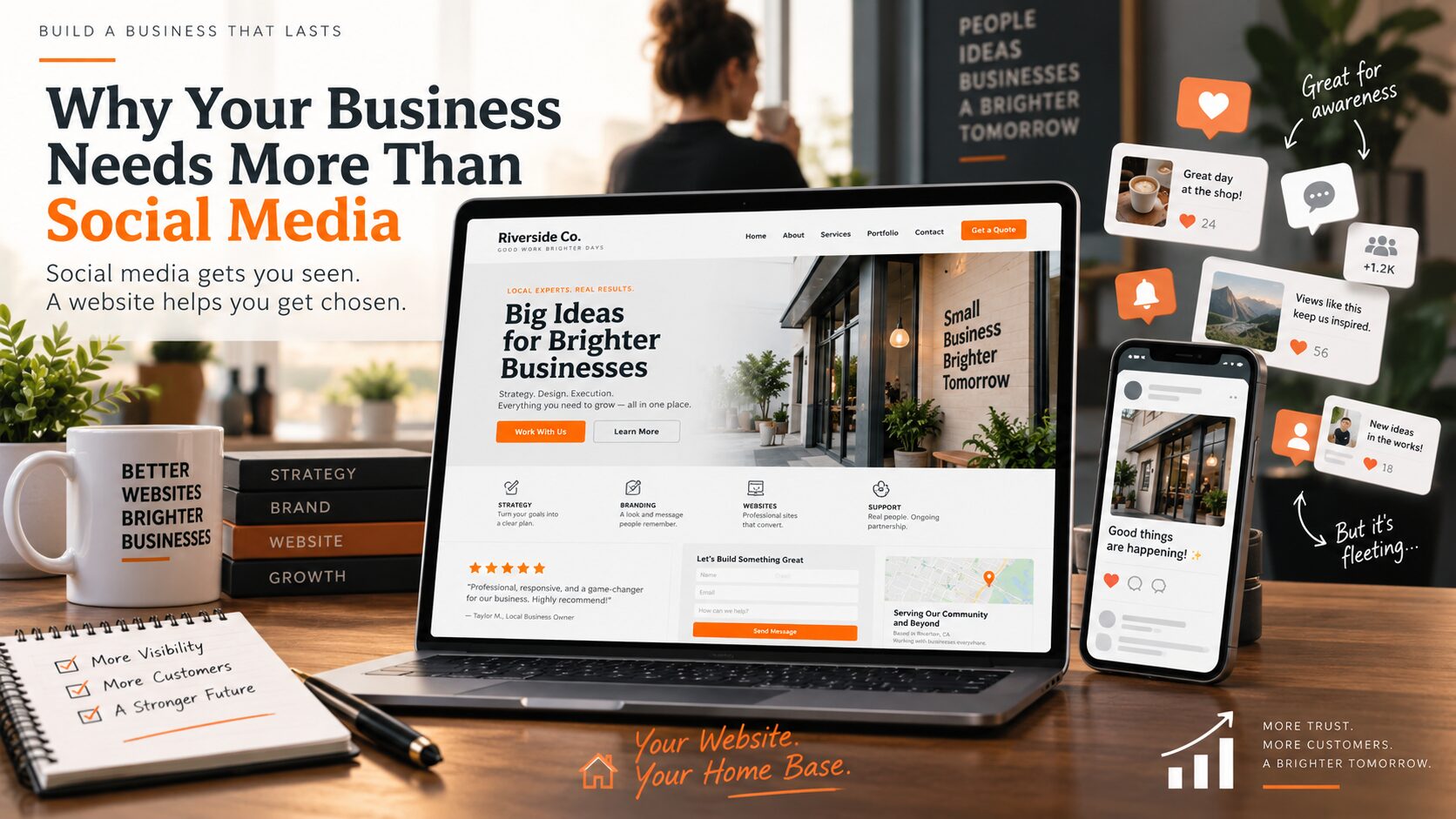
A simple way of looking at it is this: social media is rented space. Your website is your own home.
You can decorate rented space, attract people to it and make good use of it, but ultimately somebody else owns the building. They decide how things work. They decide what gets shown, who sees your posts, what the rules are, how much advertising costs and, in some cases, whether your account is allowed to keep operating at all.
That does not mean you should be suspicious of social media or stop using it. It simply means it is risky to build your entire online presence on something you do not control.
A website gives your business somewhere permanent to live online.
Social media gets attention. Your website builds confidence.
This is probably the biggest difference.
People are very happy to discover businesses on Facebook, Instagram, TikTok and other social platforms. In fact, research in South Africa has shown just how important social media has become for brand discovery.
But discovery and trust are not the same thing.
Think about what you do when you see a business on Facebook that interests you. If it is something important or involves spending a decent amount of money, there is a good chance you will Google the business name afterwards.
You want to check them out properly.
Do they have a website? Are there reviews? Does the phone number match? What services do they actually offer? How long have they been around? Do they look professional? Can you see previous work?
Without even realising it, you are asking yourself one simple question:
Is this business actually legitimate?
A proper website helps answer that question.
That becomes especially important for smaller businesses and independent service providers. A builder, plumber, cleaner, photographer, mechanic, bookkeeper or electrician may be excellent at what they do, but if their entire online presence consists of a few Facebook posts and a WhatsApp number, they can easily look less established than a competitor who may not even do better work.
The website helps level that playing field.
Your best work should not disappear down a social media feed
This is something that gets overlooked all the time.
Imagine you do a fantastic bathroom renovation and post it on Facebook. You get a few likes, some comments and maybe even an enquiry.
Great.
Then tomorrow you post something else. Next week there are five more posts. A month later that beautiful project is buried somewhere down the page where very few people will ever see it again.
A website works differently.
That same project can sit permanently under a bathroom renovations page. It can include before and after photographs, a description of the work, the area where it was completed and perhaps even a customer review.
That page can still be helping you a year or two later.
The same applies to almost any business. A mechanic can explain common repairs. A bookkeeper can answer questions people regularly ask. A photographer can build a proper portfolio. A cleaner can explain deep-cleaning services. A contractor can show completed projects.
The important thing is that the work starts becoming an asset.
Instead of disappearing after a few days, it becomes part of your business’s online history.
Google gives you opportunities that social media cannot
Another reason websites still matter is search.
People do not always search for businesses by name. Most of the time, they search for what they need.
They type things like “plumber near me”, “builder Margate”, “bookkeeper for small business”, “photographer Durban”, “inverter repair”, “tree felling Port Shepstone” or “website designer for small business”.
A proper website allows your business to be found for the things you actually do.
Of course, simply having a website does not mean you will automatically appear at the top of Google. There is competition involved, and things like content quality, location, relevance and website structure all matter.
But without a website, you are missing a huge part of the opportunity before you even start.
It is a bit like saying you do not need a shop because people can phone you. They can, but you have made it much harder for people who do not already know you exist.
AI is making this even more important
This is one of the biggest changes happening right now.
People are no longer only searching through traditional Google results. They are also asking ChatGPT, Copilot and AI-powered search tools questions.
Instead of typing “plumber Margate”, people might ask:
“Who is a reliable plumber near Margate that handles emergency repairs?”
AI systems need information to answer those questions.
They need to understand who your business is, what you do, where you operate and what information exists about you online.
A good website helps provide that information.
That means your website is no longer only something humans read. It is increasingly part of the information that search engines and AI tools use to understand your business.
So the question is slowly changing from:
“Can people find me online?”
to:
“Does the internet understand what my business actually does?”
That is a much bigger question.
Likes are nice. Customers are better.
Social media can create a strange trap for businesses because it is very easy to get excited about numbers.
You get 100 likes. A video gets 4,000 views. Your follower count grows.
That feels good, but it does not necessarily mean business is improving.
What matters is what happens after somebody sees you.
A website lets you guide people through a proper journey. They arrive, understand what you do, look at your work, read reviews, check where you operate and then contact you.
There are fewer distractions.
Facebook wants the person to keep scrolling. Instagram wants them to watch another reel. TikTok wants them to see another video.
Your website has one main job: help the visitor understand and deal with your business.
That makes it incredibly valuable.
Your website keeps working when you are not
One of the nicest things about a good website is that it does not require you to constantly perform for it.
Social media needs feeding.
You have to keep posting, commenting, creating content and staying visible.
A website does not suddenly stop being useful because you did not post something yesterday.
Someone can visit at midnight and see what you do. They can check photographs, read about your services, look at reviews, send an enquiry or find your contact information.
It works while you are sleeping.
In that sense, a website is not simply an advert. It is almost like a quiet employee that is always available to explain your business to somebody.
Social media can change. Your website gives you more control.
This is another important point.
You might have thousands of followers on a social platform, but that does not mean you can reach them whenever you want.
Algorithms decide what gets shown.
A platform can reduce your organic reach. It can change its rules. It can suspend an account. It can suddenly decide that the only way to reach more people is to pay for advertising.
Again, the point is not that social platforms are bad.
The point is that relying on one platform creates risk.
A healthier business spreads itself across several places. Social media, Google, WhatsApp, email, industry platforms, reviews and a website should all work together.
That way, your entire online business does not depend on one company changing an algorithm.
A website makes all your other marketing work harder
This is where things get interesting.
Your website is not competing with social media. It actually makes social media more useful.
Your Facebook page can send people to your website. Your Instagram bio can send people to your website. Your Google Business Profile can send people to your website.
Your WhatsApp status can link to it. Your email signature can link to it. Your vehicle branding can include it. Your business card can include it. A flyer can include it. A QR code can take people straight to it.
Instead of every marketing platform being separate, your website becomes the place everything connects back to.
That is when your online presence starts feeling like a proper business instead of a collection of accounts.
People often want to look before they talk
This matters a lot for service businesses.
It is easy to say, “If they want to know something, they can just WhatsApp me.”
But sometimes people do not want to contact you yet.
They want to browse quietly first.
They want to know whether you do the type of work they need. They want to know what area you cover. They want to see examples. They want to read reviews. They want to get a feel for whether you look professional.
Messaging someone feels like starting a conversation.
A website lets somebody investigate you without any pressure.
And every question they answer themselves brings them a little closer to contacting you.
That is one of the most valuable things a good website does.
It removes uncertainty.
Your own domain makes a difference
This may seem small, but presentation matters.
There is a different feeling between seeing:
facebook.com/somebusinessname123
and
somebusiness.co.za
The same applies to email.
There is nothing wrong with using Gmail, but there is definitely a more established feel to receiving an email from:
rather than:
A domain gives your business a digital identity.
It can appear on your quotes, invoices, vehicles, uniforms, marketing, email signatures and social profiles.
It makes everything feel connected.
For a very small business, that can make a surprisingly big difference to how customers perceive you.
For small businesses, this creates a massive opportunity
One of the interesting things about the South African market is that a large number of small businesses still do not have proper websites.
That means having one can still give you an advantage.
If there are eight electricians in your area and most of them only have Facebook pages, the electrician with a clean website, clear service information, proper photographs and customer reviews immediately feels different.
They look established.
That does not mean they are better at the job.
But customers do not know who is better yet.
They can only judge what they can see.
A good website helps a smaller provider compete with much bigger businesses without needing the same advertising budget.
That is exactly the kind of opportunity Hustlefella is trying to create.
This is where Hustlefella becomes more than another directory
Hustlefella was never supposed to be just another website where service providers dump a phone number into a directory and hope for the best.
The bigger idea is to create an ecosystem around small businesses and people who actually do the work.
Builders, cleaners, mechanics, bookkeepers, freelancers, tutors, carers, tradespeople, technicians, designers and independent professionals all need more than just one thing.
They need to be found.
They need to look credible.
They need tools to help them run their businesses.
That is where the wider Hustlefella direction comes in.
The Hustlefella Skills Network is there to help providers get found and give them a professional profile where customers can see what they offer, where they work and how to contact them.
The Growth plan is Free Forever, which means a provider does not have to take a financial risk just to establish a presence. It is not a short free trial designed to force somebody into payment later. It is intended to remain a useful option in its own right.
For providers wanting more visibility and opportunities, PRO can add additional value.
But being discovered is only the first part of the problem.
Hustlefella Sites can give the provider a proper home
This is where Hustlefella Sites fits naturally.
A provider should not have to choose between being on Hustlefella and having their own website.
Those two things should help each other.
Someone might find a provider through Hustlefella, read their profile, look at reviews and then visit the provider’s own website to learn more.
That website can give them a much deeper look at the business.
More photographs. More information. A full service breakdown. About pages. FAQs. Projects. Contact details. Testimonials.
Hustlefella can help somebody find you.
Your website helps convince them you are worth contacting.
That relationship makes sense.
The other important thing is simplicity.
Most tradespeople and small business owners do not want to learn about hosting, domains, security certificates, backups, SEO, layouts and technical jargon.
They want a good website.
That is it.
Hustlefella Sites is being built around that idea: the technology should support the provider, not become another job they have to learn.
Hustlefella Books tackles the next problem
Getting work is only one side of business.
Once customers start arriving, you still have to manage everything behind the scenes.
Customers, quotes, invoices, expenses, payments, records, reporting and general admin.
That is where Hustlefella Books comes in.
If you look at the typical small business today, everything is scattered.
Facebook for marketing. WhatsApp for messages. A separate website. Another company for hosting. Spreadsheets for customers. Another system for invoices. Another piece of software for bookkeeping.
Each one has another login, another subscription and another learning curve.
The long-term Hustlefella idea is much more connected.
Help the provider get found.
Help them present themselves properly.
Help them manage the business once the work arrives.
That is why the Skills Network, Hustlefella Sites and Hustlefella Books belong together.
The Skills Network says: find me.
Hustlefella Sites says: this is who I am, this is what I do and this is why you can trust me.
Hustlefella Books says: now help me run the business properly.
That is much more powerful than three unrelated products.
Social media should support your website, not replace it
None of this means you should stop using Facebook or Instagram.
Use them.
Post your work. Show your personality. Share reviews. Join local groups. Answer questions. Post videos. Keep your business visible.
But use those platforms for what they are good at.
Let social media introduce you.
Let your Hustlefella profile help people discover you.
Let your reviews build confidence.
Let your website tell the full story.
Let WhatsApp create the conversation.
And let your business systems help you manage what happens afterwards.
That is a much healthier way to build an online presence.
A website is no longer just an online brochure
Years ago, websites were very basic.
Home.
About.
Services.
Contact.
That was about it.
Today, a website can do much more.
It can act as a salesperson, portfolio, receptionist, booking system, enquiry system, knowledge base, shop, customer service tool and marketing platform.
It can help customers find you.
It can help Google understand you.
It can help AI tools understand you.
It can give your social media somewhere useful to send people.
And most importantly, it becomes something that gets stronger over time.
Every project you add makes it better.
Every review adds credibility.
Every useful page improves what people can learn about you.
Every year gives your business a deeper digital footprint.
That is very different from a Facebook post that disappears down the feed after two days.
Small businesses deserve better than having to buy attention
Large companies can throw money at marketing.
They can pay agencies. They can buy Google Ads. They can run huge Facebook campaigns. They can sponsor content and dominate search results.
A small business often cannot do that.
Yet the small business might be better.
The plumber working out of one van might care more about the customer than the national company.
The independent bookkeeper may give better service than the big firm.
The local builder may have spent twenty years learning their trade.
They deserve a chance to be found.
That is the space Hustlefella is trying to help create.
A Hustlefella profile can help somebody discover the provider.
A Hustlefella Site can give that provider a professional online home.
Hustlefella Books can help them manage the business that grows from it.
Social media can then amplify all of it.
That is a much stronger position than simply chasing likes and hoping somebody happens to send a WhatsApp.
So no, social media is not going away and businesses should not ignore it.
But your business deserves more than a social profile.
It deserves a place of its own.
A place customers can find.
A place they can trust.
A place that tells your full story.
A place that keeps working long after today’s post has disappeared.
That is what a good website gives you.
And that is the bigger idea behind where Hustlefella is heading.
Get found. Build trust. Win the work. Run the business. Grow.
Hustlefella — Boots Over Suits.